
Written by an audiologist · Last updated 3 November 2026 · Prices checked November 2026
A CROS hearing aid is for people who are deaf, or close to it, in one ear and hear well in the other. A small transmitter on the deaf side picks up sound and sends it wirelessly to a hearing aid on the hearing side, so you stop missing conversation on your “bad side”. If the better ear also has a hearing loss, the same system is programmed as BiCROS. At Aid My Hearing a Signia CROS transmitter costs £595–£745 and a complete set (transmitter plus the hearing aid for your better ear) starts at £1,240, fitted remotely by a UK audiologist with a 60-day money-back trial.

Hear from both sides again — without an operation
What single-sided deafness actually feels like
Audiologists use the term single-sided deafness for a specific situation: one ear that is profoundly deaf or so damaged that a hearing aid cannot make its sound useful, alongside an ear that hears normally or nearly so. It can be present from birth, but more often it arrives suddenly in adulthood — after a viral infection or sudden sensorineural hearing loss, Ménière’s disease, a head injury, or surgery to remove an acoustic neuroma.
Because the good ear still works, people around you often assume the problem is minor. It is not. The head itself blocks higher-pitched sounds (the “head shadow”), so anything said on your deaf side arrives at the hearing ear muffled and quieter. The things people tell us they struggle with most are the same every time: a passenger in the car, the person next to them at dinner, a colleague leaning over at a desk, walking along a pavement with someone on the wrong side, and knowing which direction a voice or a car is coming from.
Why an ordinary hearing aid does not help a dead ear
A conventional hearing aid makes sound louder and clearer, then delivers it into the ear it sits on. That only works if the inner ear and hearing nerve on that side can still turn the sound into something the brain can use. When the cochlea or nerve has stopped working, turning the volume up produces distortion or nothing at all. This is why audiologists describe such an ear as unaidable: the problem is not loudness, it is that the pathway is closed.
So instead of trying to force sound into the deaf ear, a CROS system takes a different approach and simply delivers that sound to the ear that can hear it.
How a CROS hearing aid works
CROS stands for Contralateral Routing Of Signal — literally, sending the signal to the opposite side. A set has two pieces:
- The CROS transmitter sits on (or in) the deaf ear. It looks like a hearing aid but it has no speaker of its own — it is a microphone and a radio.
- The receiving hearing aid sits on the hearing ear. It plays the sound the transmitter sends, mixed with the sound its own microphones pick up on that side.
The result is that your hearing ear hears both sides of the room. The transfer is near-instant, so a voice on your deaf side no longer sounds muffled or delayed. Modern systems such as the Signia IX CROS range use the same low-power wireless link that lets a pair of hearing aids talk to each other, and both pieces are rechargeable — you drop them in the charger overnight.
CROS or BiCROS?
If your better ear hears normally, the receiving aid is set up purely as a receiver: this is CROS. If your better ear also has a hearing loss — which is common as people get older — the receiving aid is programmed to amplify sound for that ear too. That configuration is called BiCROS. The hardware is identical; only the programming changes, and your audiologist decides which you need from your hearing test.
Who CROS hearing aids suit — and their limits
A CROS or BiCROS system is usually the right first step for an adult with one unaidable ear. It is non-surgical, it can be trialled, it is far cheaper than an implant, and for most people it removes the single biggest frustration of single-sided deafness: missing what is said on the deaf side.
It is also worth being clear about what it will not do:
- It does not restore hearing in the deaf ear. Everything is still heard through the one good ear.
- It does not fully restore your sense of direction. Telling where a sound comes from relies on comparing two ears. With one ear doing all the listening, localisation stays difficult, although many people learn to use the slight difference in sound quality between the two microphones as a cue.
- Noisy rooms are still hard. A CROS set adds the deaf side’s sound, including its noise. Good directional microphones and a settings-rich receiving aid (a 5IX or 7IX rather than a 1IX) make a real difference here, and you can mute the transmitter in situations where it is not helping.
For people who want to hear with the deaf side rather than from it, the surgical options are a bone-conduction implant (which sends vibration through the skull to the good cochlea) or, in selected cases, a cochlear implant in the deaf ear. Both are assessed by an NHS ENT and audiology team, and a CROS trial is often part of that assessment.
Can you get CROS hearing aids on the NHS?
Often, yes. Many NHS audiology departments across England, Scotland, Wales and Northern Ireland fit CROS and BiCROS systems for single-sided deafness, and if you qualify they are free, with free batteries and repairs. Provision is not identical everywhere, though: the models offered are typically basic behind-the-ear devices, some areas have long waits, and Bluetooth streaming, rechargeable batteries and smaller in-ear designs are rarely available.
The route is simple: ask your GP for a referral to audiology and say clearly that you have hearing in one ear only and want to be assessed for a CROS system. If you have a recent sudden hearing loss, say so — that needs urgent ENT attention, not just a hearing aid.
People come to us privately for CROS mainly for three reasons: they do not want to wait, they want a discreet or in-ear design, or they want a receiving aid that streams calls and music from their phone. All four Signia CROS sets below are rechargeable and the receiving aid in each has Bluetooth and app control.
CROS hearing aid prices in the UK (November 2026)
Every CROS price you see quoted — ours included — is for the transmitter only. You also need one hearing aid for your better ear, so the figure that matters is the complete set. Our CROS transmitters come with a 5-year warranty as standard (a 2-year-warranty option is £50 less), and you choose the technology level of the receiving aid to suit your budget and how much noise you deal with.
| Style | CROS transmitter | Cheapest partner aid (single) | Complete set from | Top-spec set | |
|---|---|---|---|---|---|
| Signia Silk Charge&Go IX CROS | In-ear, nearly invisible | £595 | Silk 1IX £645 | £1,240 | Silk 7IX: £1,695 |
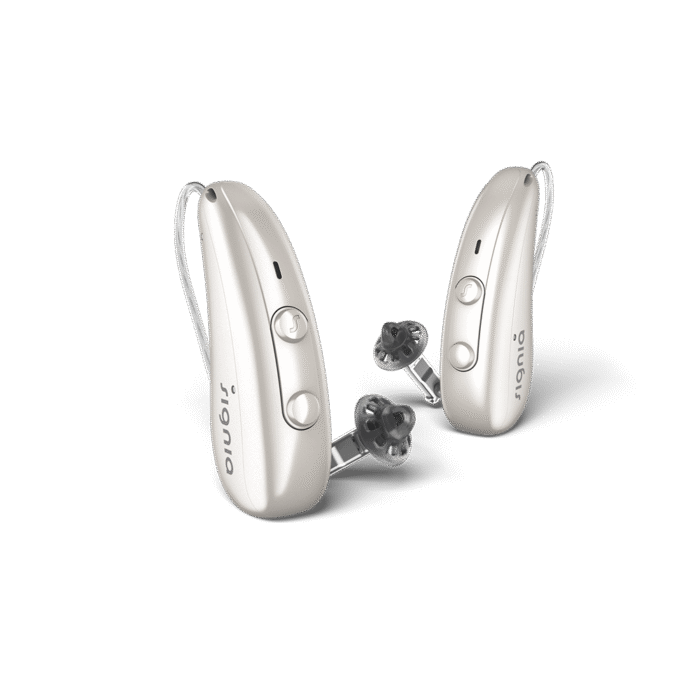
| Signia Pure Charge&Go IX CROS | Behind-the-ear, receiver-in-canal | £695 | Pure 1IX £640 | £1,335 | Pure 7IX: £1,730 |
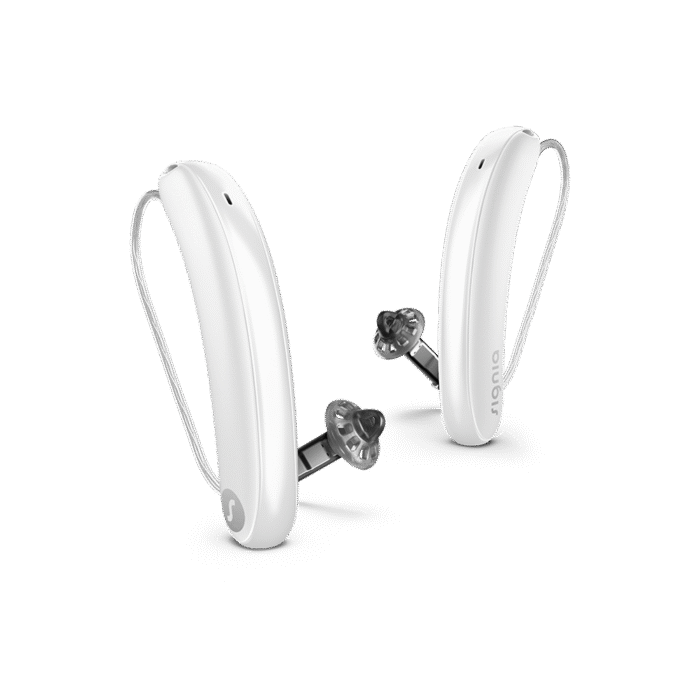
| Signia Styletto IX CROS | Slim-line behind-the-ear | £695 | Styletto 3IX £845 | £1,540 | Styletto 7IX: £1,795 |
| Signia Active IX CROS | Earbud style, in-ear | £745 | Active IX £800 | £1,545 | Active Pro IX: £1,945 |
Aid My Hearing prices, 5-year warranty, checked 3 November 2026. Partner-aid prices are for a single hearing aid; 2-year-warranty versions are available on most models for less. Every set includes remote programming by a UK audiologist, free aftercare and a 60-day money-back trial.
For comparison, the same transmitter-plus-aid set from a high-street private clinic usually costs a good deal more, because clinic time and premises are bundled into the price. Our hearing aid prices page explains how we keep ours lower, and all four CROS sets are also covered by our price-match promise.
Which Signia CROS set should you choose?
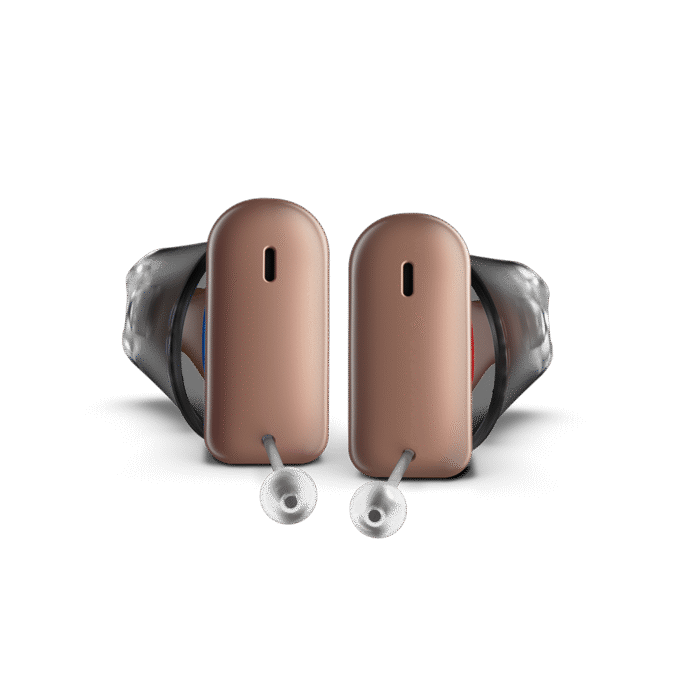
- Both pieces sit inside the ear canal — nothing behind the ear
- Ready to wear with soft click sleeves, no custom mould
- Lowest complete-set price at £1,240
- Receiver-in-canal design with the widest choice of partner aids (1IX–7IX)
- Strongest option for noisy places when paired with a 5IX or 7IX
- Complete set from £1,335
- Narrow, pen-shaped housing that sits flat against the head
- Same chip and sound as Pure; style choice rather than a performance one
- Complete set from £1,540
- Looks like a wireless earbud rather than a hearing aid
- Good for occasional and situational use
- Complete set from £1,545
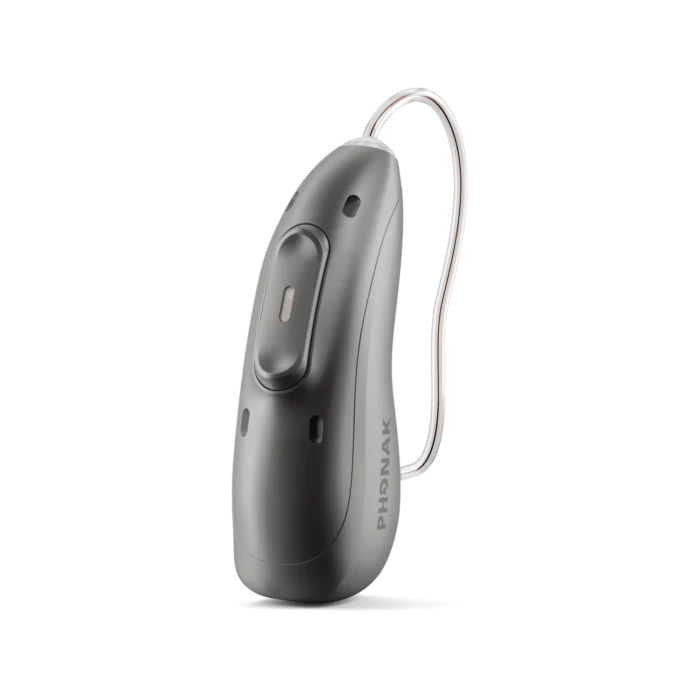
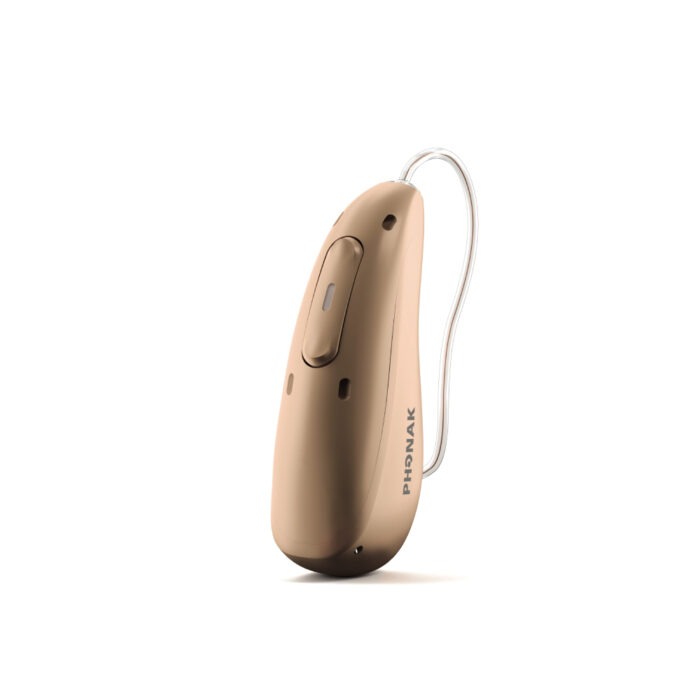
If you are not sure which partner aid to choose, our rule of thumb is this: a 1IX or 3IX receiving aid is fine for mostly quiet, one-to-one listening; a 5IX or 7IX is worth the extra if you spend time in restaurants, meetings or around children. Phonak also make a CROS transmitter for the Audéo EON range (the standard EON, not the EON Sphere) — we can supply it on request, so get in touch if you already wear Phonak.
Send us your hearing test, or book a free consultation and our audiologist will tell you honestly whether a CROS system will help, which set suits you and whether the NHS route is worth trying first.
How buying a CROS set from us works
Choose your transmitter and partner aid online (or ask us to put the set together for you), send us your audiogram, and we programme the receiving aid for your better ear before it is posted. Once it arrives, a remote fitting appointment checks the balance between the two sides and sets up the transmitter mute and the app. You then have 60 days to decide: if it is not working for you, send it back for a full refund. Aftercare and reprogramming are free for as long as you own the aids.
Frequently asked questions
A CROS transmitter on its own costs £595–£745 at Aid My Hearing with a 5-year warranty (£50 less on a 2-year warranty). You also need one hearing aid for the better ear, so a complete Signia CROS set starts at £1,240 (Silk CROS + Silk 1IX) and tops out around £1,730 for the Pure CROS with a Pure 7IX. Private clinics on the high street typically charge considerably more for the same set.
Often, yes. Many NHS audiology departments fit CROS and BiCROS systems for single-sided deafness, although the models offered and the waiting times vary from area to area. Ask your GP for a referral to audiology and say specifically that you have hearing in one ear only. If you would rather not wait, or you want a smaller rechargeable or Bluetooth model, buying privately is the alternative.
No. Nothing is heard through the deaf ear itself — the CROS transmitter simply moves the sound from that side across to your hearing ear. What changes is that you no longer miss speech coming from your deaf side, which for most people is the main day-to-day problem of single-sided deafness.
CROS is for people whose better ear hears normally: the receiving hearing aid just plays the sound sent from the other side. BiCROS is for people whose better ear also has some hearing loss: the receiving aid amplifies sound for that ear as well as playing what the transmitter sends. The hardware is the same — your audiologist simply programmes the receiving aid differently.
Yes. We need a recent hearing test (audiogram) for both ears so we can confirm that a CROS or BiCROS system is suitable and programme the receiving aid correctly for your better ear. If you do not have one, we can arrange a hearing test for you, or you can send us the one from the NHS or a previous clinic.
Yes. The receiving hearing aid in a Signia IX CROS set is a standard Signia IX hearing aid, so it streams phone calls and music from iPhone and Android, works with the Signia app, and is rechargeable. The CROS transmitter itself has no streaming of its own — it just sends sound across to the receiving aid.
Related reading
- All CROS hearing aids — the four Signia sets with current prices
- Hearing aid prices UK 2026 — every model we sell, single and pair
- Cheapest hearing aids UK — where the real savings are
- Buying hearing aids online — how remote fitting works
Sources: NHS: Hearing loss · RNID: Single-sided deafness · NICE NG98: Hearing loss in adults



Contact Aid My Hearing
If you have any questions, need advice, or would like more information about our hearing services, please complete the contact form and a member of the Aid My Hearing team will get back to you as soon as possible.
Prefer to speak to us directly? Call 0208 0361 110 or email info@aidmyhearing.co.uk
