
Written by an audiologist · Last updated 2 October 2026 · Prices checked on the day of publication
The Phonak Audéo EON R is the sensible Phonak. It shares the EON Sphere’s new 2026 body, 38-hour rechargeable battery, universal Bluetooth and myPhonak app, but leaves out the separate AI noise chip — and costs £1,615–£2,250 a pair at Aid My Hearing as a result. For anyone whose days are mostly quiet or moderately busy, it hears the same as the Sphere and saves £175–£525. The two things to know before you buy: there is no telecoil, and in genuinely loud rooms the Sphere is better.

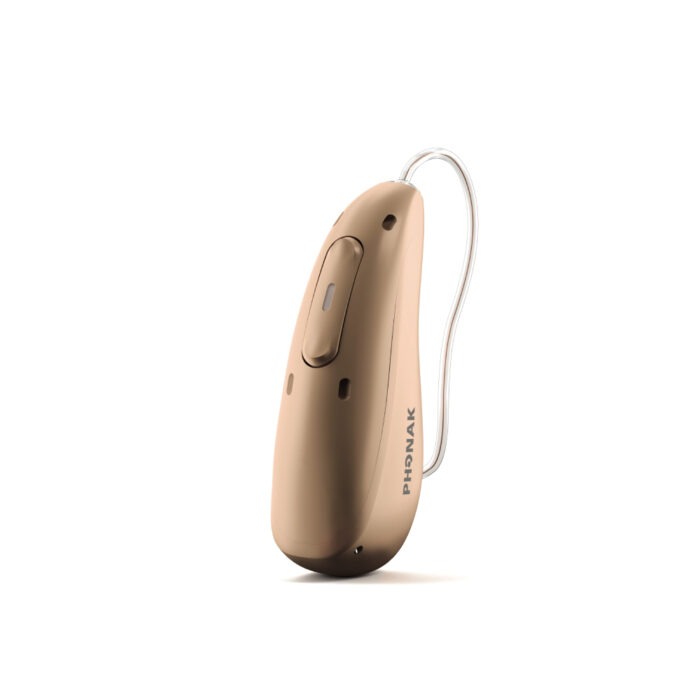
The same 2026 Phonak body and battery, without the AI chip — and without the AI price.
Where the EON R sits in Phonak’s 2026 range
Phonak launched two hearing aids on its new EON platform in September 2026. The Audéo EON Sphere is the flagship, with a second processor dedicated to pulling voices out of background noise. The Audéo EON R is everything else about that hearing aid — the body, the battery, the Bluetooth, the app — with Phonak’s conventional AutoSense OS AI 8.0 doing the listening instead of a dedicated chip.
That makes it the direct successor to the Audéo Lumity and Infinio (non-Sphere) aids that most Phonak wearers in the UK are actually using, and the obvious upgrade path for them. It is also, in our view, the Phonak most people should be looking at first — then stepping up to the Sphere only if their hearing test and their lifestyle justify it.
What is actually new
The EON body is 25% smaller and 20% lighter than the previous Sphere, which matters more than it sounds if you wear glasses or have small ears. Battery life rises to up to 38 hours on a charge, and because there is no second processor to feed, the EON R stays closer to that figure in real use than its sibling. WindBlock 2.0 is new and noticeably better on a walk or a bike. Auracast broadcast audio is built in alongside universal Bluetooth, and the aids remain fully compatible with Phonak’s Roger microphones and the TV Connector.
Underneath, AutoSense OS AI 8.0 is the latest version of Phonak’s automatic program. It listens to the room, classifies it — calm, speech in noise, music, car and so on — and blends the right settings without you touching anything. It is trained with machine learning, which is where the “AI” in the name comes from, but it is not the same thing as the Sphere’s dedicated noise-separation chip. We explain the practical difference in the EON R vs EON Sphere comparison.
E90, E70, E50 or E30 — what you get at each level
Four levels, one body. Everything physical is identical: battery, Bluetooth, app, water rating and warranty. What you are buying as you go up is how many of Phonak’s speech-focus tools are switched on, and how finely your audiologist can tune the sound.
| E90 | E70 | E50 | E30 | |
|---|---|---|---|---|
| Our price — both ears | £2,250 | £2,055 | £1,970 | £1,615 |
| Our price — one ear | £1,100 | £1,000 | £960 | £780 |
| Typical UK clinic price (pair) | £3,000–£3,600 | £2,700–£3,200 | £2,400–£2,900 | £1,900–£2,400 |
| Best for | Busy weeks, soft voices, groups | Most people — the value level | Mostly quiet, occasional noise | Home, TV and one-to-one |
Aid My Hearing prices, October 2026. Clinic ranges are indicative of published UK private pricing for equivalent technology levels.
- Softly spoken or distant people are your biggest struggle — Speech Enhancer and SpeechSensor are E90-only
- You are in groups and busy places most weeks but do not want to pay for the Sphere chip
- You want the most your audiologist can fine-tune
- You want StereoZoom 2.0 and Dynamic Noise Cancellation for restaurants and meetings
- You want the same 20 tuning channels as the E90
- You would rather save £195 and spend it on a TV Connector
- Most of your days are quiet — home, one-to-one, television
- You want rechargeable, universal Bluetooth and the myPhonak app without paying for noise tools you will not use
- This is your first hearing aid and you want a gentle, honest starting point
Send us your audiogram or book a free ten-minute call. Our audiologist will tell you honestly which level your hearing test justifies — including when the cheaper one is the right answer.
Living with it: battery, charging and connectivity
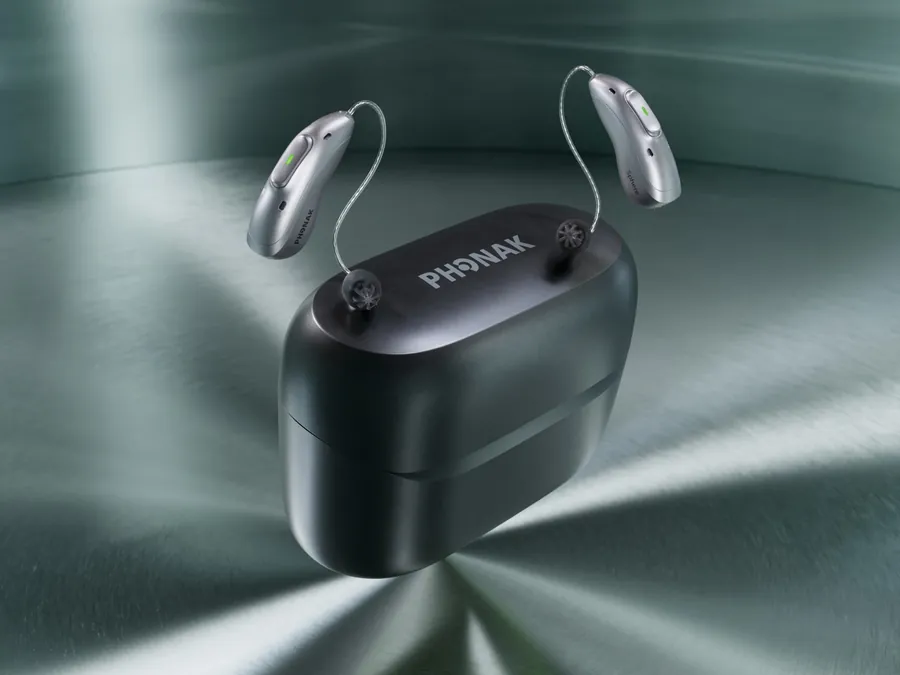
The EON R is rechargeable only — there is no disposable-battery version. The standard desktop charger (Charger RIC E) is in the box, and the optional portable charger carries about three extra full charges for travel. A full charge takes roughly 2.5 hours; a top-up while you shower buys several hours.
Connectivity is the part Phonak does better than anyone. Universal Bluetooth Classic means the aids simply work with any phone — iPhone, any Android, laptops, tablets, Bluetooth TVs — with no intermediate streamer. Calls are properly hands-free, because the aids’ own microphones pick up your voice while the phone stays in your pocket. Tap control lets you answer a call or pause music with a double tap on the ear. LE Audio and Auracast are built in for the broadcast audio now appearing in theatres, airports and gyms.
The myPhonak app handles volume, programs, a noise-reduction slider and remote fine-tuning sessions with our audiologist. It also offers basic health tracking — step count and wearing time — if you want it.
What the EON R does not have — the honest bit
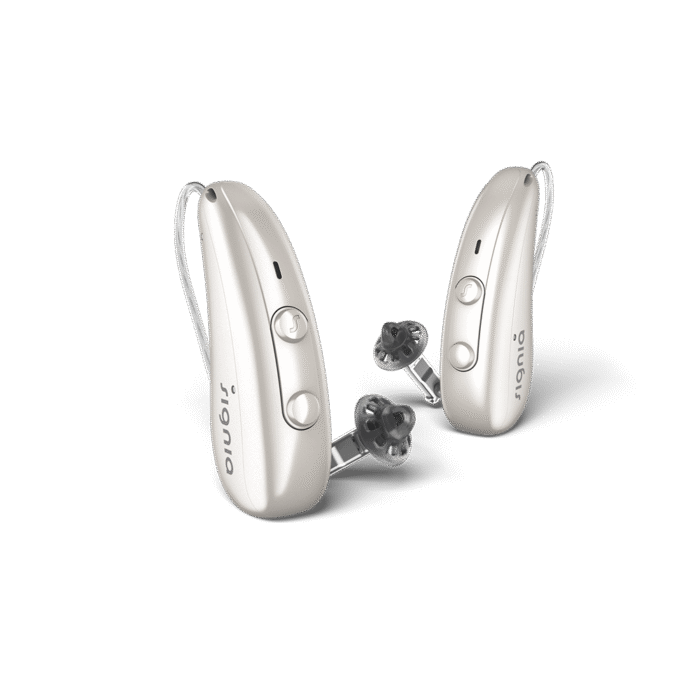
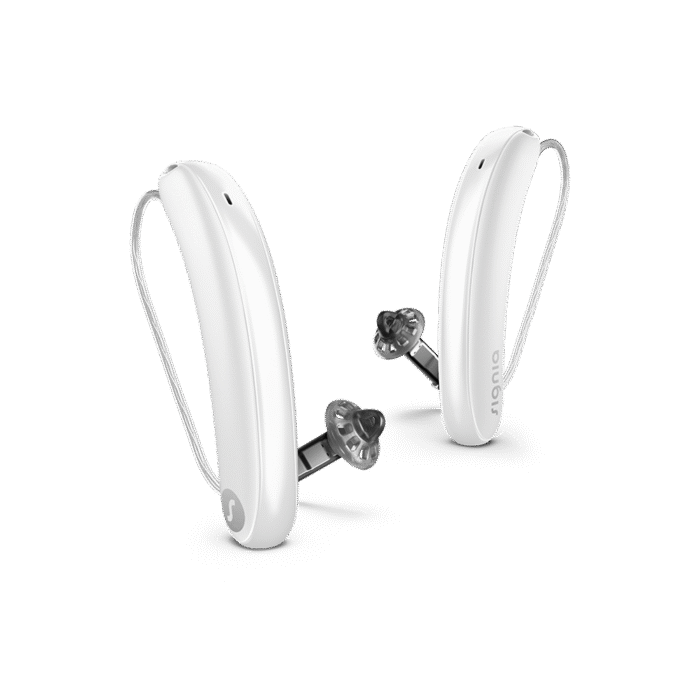
No telecoil. Phonak has removed it from the entire EON platform. If hearing loops in churches, theatres, banks and at ticket counters matter to you, that is a real loss, and Auracast is not yet a practical replacement in Britain. The Signia Pure Charge&Go MaX keeps a telecoil and is the aid we would point you to instead.
No Spheric noise mode. This is the whole point of the price difference, and it is worth being clear about: in a genuinely loud room — a busy restaurant with hard floors, a wedding, a pub on a Saturday — the EON Sphere will let you follow conversation that the EON R will not. If that is the situation you dread most, the Sphere is worth the extra. If it is a few evenings a year, it probably is not.
No own-voice processing in the Signia sense. Phonak handles your own voice well, but if a boomy own voice is the thing you most want to avoid, Signia’s Own Voice Processing is the more direct answer.
What is what on the hearing aid
-
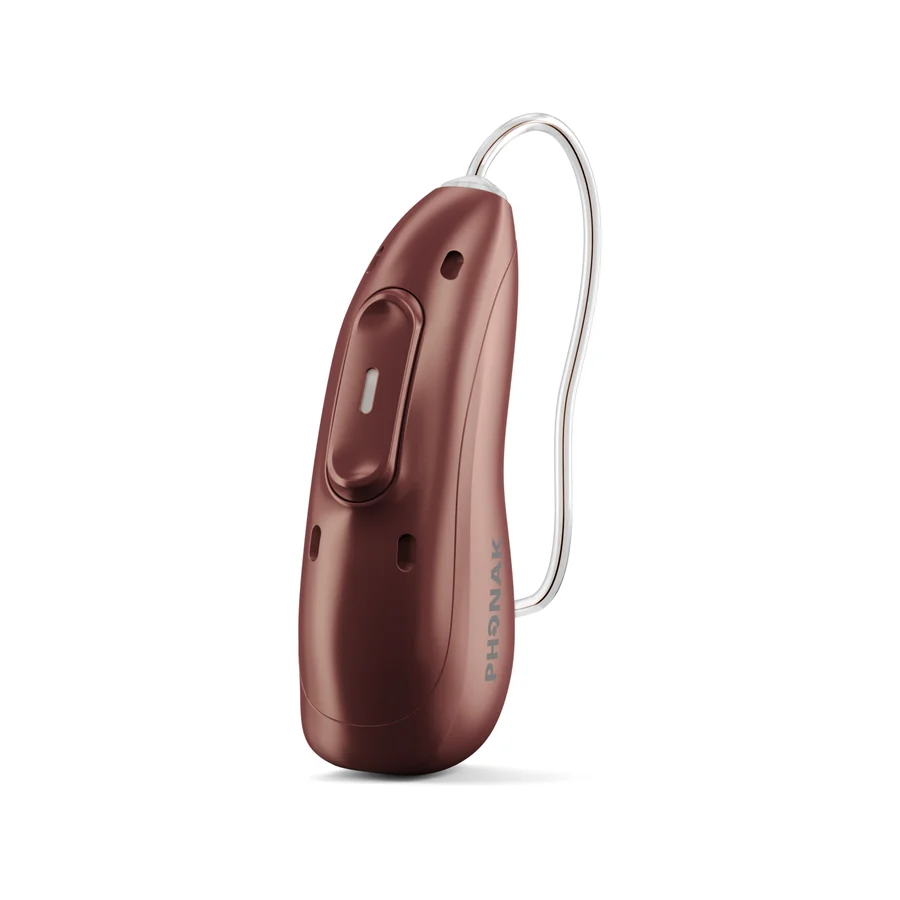
1Microphones — two mics behind the ear pick up sound from every direction
-
2Push button — volume, programs, answer or end a call — no phone needed
-
3Receiver wire — thin and almost invisible; supplied in the right length for your ear
-
4Receiver & dome — sits in the ear canal; we fit the right power and dome for your loss
-
5Charging contacts — drop it in the charger overnight — no batteries to change
Our verdict
The EON R is the Phonak we expect to fit most often this year, and that is a compliment. It has everything that makes the EON platform good — the smaller body, the all-day battery, the Bluetooth that just works, the app — at a price that starts under £1,620 a pair. For most people with a mild-to-moderate loss who spend most of their time in ordinary places, the E70 at £2,055 is the level we would choose for a member of our own family.
Two groups should look elsewhere: anyone who relies on hearing loops, and anyone whose hardest hours are spent in loud rooms — for them the EON Sphere is worth the extra, and until 31 October 2026 a Sphere pair also comes with the £369.95 portable charger free.
Every EON R we sell is programmed to your own hearing test by a UK audiologist before it is posted, backed by a 5-year warranty and a 60-day money-back trial. If it turns out not to suit you, you send it back.
Frequently asked questions
At Aid My Hearing the EON R costs £2,250 a pair for the E90, £2,055 for the E70, £1,970 for the E50 and £1,615 for the E30 (October 2026). One aid is £780–£1,100. Every price includes programming to your hearing test by a UK audiologist, the charger, a 5-year warranty, a 60-day money-back trial and free remote aftercare.
They share the same 2026 body, 38-hour battery, universal Bluetooth, Auracast and myPhonak app. The Sphere adds a second processor — the HYPERSONIC AI chip — whose only job is separating voices from background noise, and Phonak measures its benefit at up to 10.2 dB on the Sphere E90. The EON R relies on Phonak’s conventional AutoSense OS AI 8.0 processing instead. In quiet and moderately busy places the two hear much the same; in loud rooms the Sphere pulls ahead. The EON R E90 is £175 less than the Sphere E90 a pair. We compare them in full in EON R vs EON Sphere.
For most people the E70 is the sweet spot: it has the 20 fine-tuning channels, StereoZoom 2.0 and Dynamic Noise Cancellation of the E90, and only drops Speech Enhancer and SpeechSensor. Choose the E90 if soft or distant voices are a real problem. Choose the E50 if your days are mostly quiet with the occasional busy room. The E30 is a sensible first hearing aid for someone who is mainly at home and wants rechargeable Bluetooth without paying for features they will not use.
Phonak quotes up to 38 hours on a full charge without streaming. Because the EON R has no power-hungry AI chip to run, it tends to stay closer to that figure in real use than the Sphere does; a heavy day of calls and television through the aids will still comfortably see you through to bedtime. A full charge takes about 2.5 hours.
No. Like the EON Sphere, the EON R has no telecoil. If you rely on hearing loops in churches, theatres, banks or at ticket counters, look at the Signia Pure Charge&Go MaX instead, which keeps one. The EON R does support Auracast broadcast audio, which is slowly replacing loops, but few UK venues have it yet.
Yes — with both, without a separate streamer. Universal Bluetooth Classic plus LE Audio means calls, music and TV stream straight to both ears from any iPhone, any Android, laptops and tablets. You can keep 8 devices paired and 2 connected at once, and calls are hands-free because the aids’ own microphones pick up your voice.
Yes. Phonak makes a CROS EON R for people with no usable hearing in one ear: a transmitter on the poorer side sends sound across to an EON R on the better side. If this is you, contact us and we will quote the right pairing for your audiogram.
Eight colours, including the new Sienna Red alongside the usual beiges, greys, silver and black. Most people choose a shade close to their hair colour, which is what makes the aid disappear behind the ear.
Related reading
- Phonak EON R vs EON Sphere — is the AI chip worth the difference?
- Phonak Audéo EON Sphere review — the flagship, reviewed
- Phonak EON Sphere price UK — what it costs and how to pay less
- The best hearing aids in 2026 — our audiologist’s picks by category



Contact Aid My Hearing
If you have any questions, need advice, or would like more information about our hearing services, please complete the contact form and a member of the Aid My Hearing team will get back to you as soon as possible.
Prefer to speak to us directly? Call 0208 0361 110 or email info@aidmyhearing.co.uk
