

The hearing aid nobody can see — explained properly
Written by an audiologist · Last updated 23 September 2026 · Prices checked on the day of publication
The Signia Silk is the invisible hearing aid we recommend most. It sits fully inside the ear canal, fits in minutes with soft sleeves, and suits mild to moderate hearing loss. There are two families: the rechargeable Silk Charge&Go IX (from £1,145 a pair) and the battery-powered Silk X (from £1,050 a pair). For most people the sweet spot is the Silk 3IX at £1,540 a pair. What you give up for invisibility is Bluetooth streaming — if you want the phone and TV in your ears, a behind-the-ear aid is the better buy.
What is the Signia Silk?

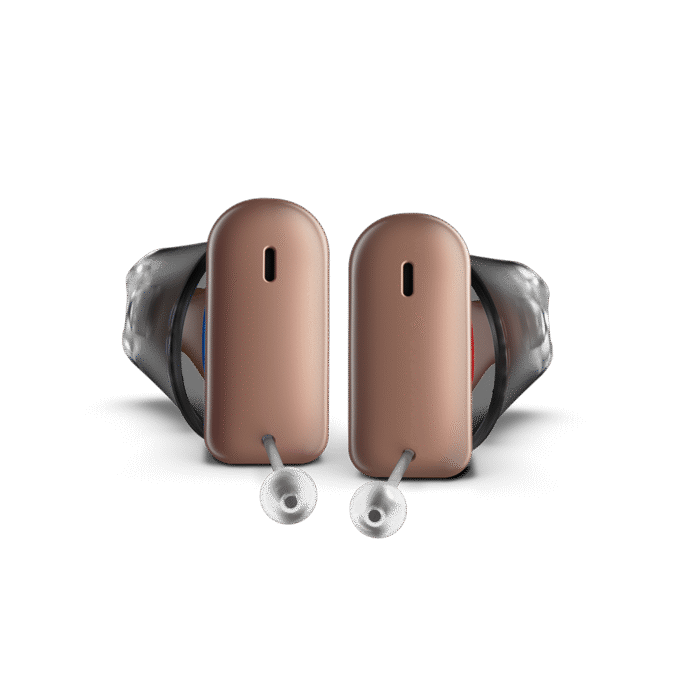
The Silk is Signia’s completely-in-canal (CIC) hearing aid. The whole device sits inside the ear canal, so there is nothing behind the ear, nothing over it and no wire. From a step away it is invisible; up close, all that shows is a tiny clear pull-cord.
What makes it different from the custom-made invisible aids of a few years ago is that it is ready to wear. Instead of taking an impression of your ear and waiting weeks for a shell to be made, the Silk uses soft silicone Click Sleeves that come in several sizes and swap in seconds. That is why we can programme a pair to your hearing test and post them to you, and why a return or exchange is simple if the fit is not right.
There are two families on sale in the UK in 2026, and the names cause a lot of confusion:
- Silk Charge&Go IX — launched in late 2023. Rechargeable, on Signia’s current IX chip. Colours: Mocha or Black.
- Silk X — launched in 2020. Runs on a size-10 disposable battery, on the previous Xperience chip. Mocha or Black.
Each family comes in five technology levels — 1, 2, 3, 5 and 7 — which is where the price difference comes from. We will untangle both decisions below.
Who the Silk suits — and who it does not
We would rather lose a sale than send an invisible aid to someone it will frustrate, so here is the honest list. The Silk is a great choice if:
- your hearing loss is mild to moderate (most first-time wearers are)
- not being noticed is the reason you have been putting hearing aids off
- you mainly want to hear conversation, the television at a normal volume, and the world around you — rather than stream your phone
- you are comfortable handling something about the size of a coffee bean
It is probably the wrong choice if you have a severe hearing loss (it does not have the power), if you take a lot of phone calls and want them streamed straight into your ears, if you have arthritis or a tremor that makes tiny things hard, or if you have been told your ear canals are unusually narrow. None of those is a criticism of the Silk — they are simply what you trade for invisibility, and a discreet behind-the-ear aid solves all of them.

Silk Charge&Go IX vs Silk X: what is actually different
People search for “Silk IX vs Silk X” expecting a long list. It is a short one. The shape, the fit, the sleeves, the app and the invisibility are the same. Three things differ.
1. Power. The Silk IX is rechargeable — up to 28 hours from a full charge, about four hours to fill, and a 30-minute top-up buys around six hours. It comes with a pocket-sized charging case that stores up to three extra charges, and the case itself charges wirelessly on a Qi pad. The Silk X uses a size-10 zinc-air battery that lasts around 70 hours, so most people change it once a week. Some people love never having to charge anything; others find the tiny battery and door fiddly. Be honest with yourself about which you are.
2. The chip. The IX runs Signia’s current Integrated Xperience platform; the X runs the previous Xperience platform. In everyday terms the IX is the more refined listener in busy places — the premium 7IX, for example, adds automatic echo control and an extended 12 kHz sound range. For quiet, one-to-one lives the X still sounds excellent.
3. Price. The X is £90–£200 a pair cheaper than the IX at the same level, and it is the cheapest invisible hearing aid we sell that we are happy to put our name to.

| Silk Charge&Go IX | Silk X | |
|---|---|---|
| Launched | October 2023 | 2020 |
| Power | Rechargeable — up to 28 h per charge | Size-10 battery — around 70 h |
| Charging case | Portable, holds up to 3 extra charges, Qi wireless | Not needed |
| Sound platform | Signia IX (current) | Signia Xperience (previous) |
| Fit | Ready-to-wear Click Sleeves; custom option | Ready-to-wear Click Sleeves, 4 sizes |
| App & remote | Signia App, miniPocket | Signia App, miniPocket |
| Bluetooth streaming | No | No |
| Tinnitus features | Levels 2–7 | Levels 2–7 |
| Single-sided (CROS) | Yes — Silk Charge&Go CROS | Yes — CROS Silk X (ask us) |
| Colours | Mocha, Black | Mocha, Black |
| Pair price | £1,145 – £2,045 | £1,050 – £1,845 |
Our take: if the budget stretches, buy the Silk IX. Rechargeable is simply easier to live with, and you get the newer processing. If price is the deciding factor, the Silk X gives you the same invisibility for £90–£200 less and we fit a lot of very happy people with it.
The technology levels: 1, 2, 3, 5 and 7 explained
This is where most people get stuck, so here is the plain-English version. Every level of the Silk IX is the same hearing aid — same size, same battery, same fit, same app. What you pay for as you go up is how much help it gives you in difficult places: noisy restaurants, wind, echoey halls, and music.
The one step that matters more than any other is 3IX. It is the first level with Binaural OneMic Directionality — the two aids talk to each other and work together to favour the voice in front of you over the noise around you. Below it (1IX and 2IX) the aids hear everything equally well in every direction, which is fine at home and hard work in a café.
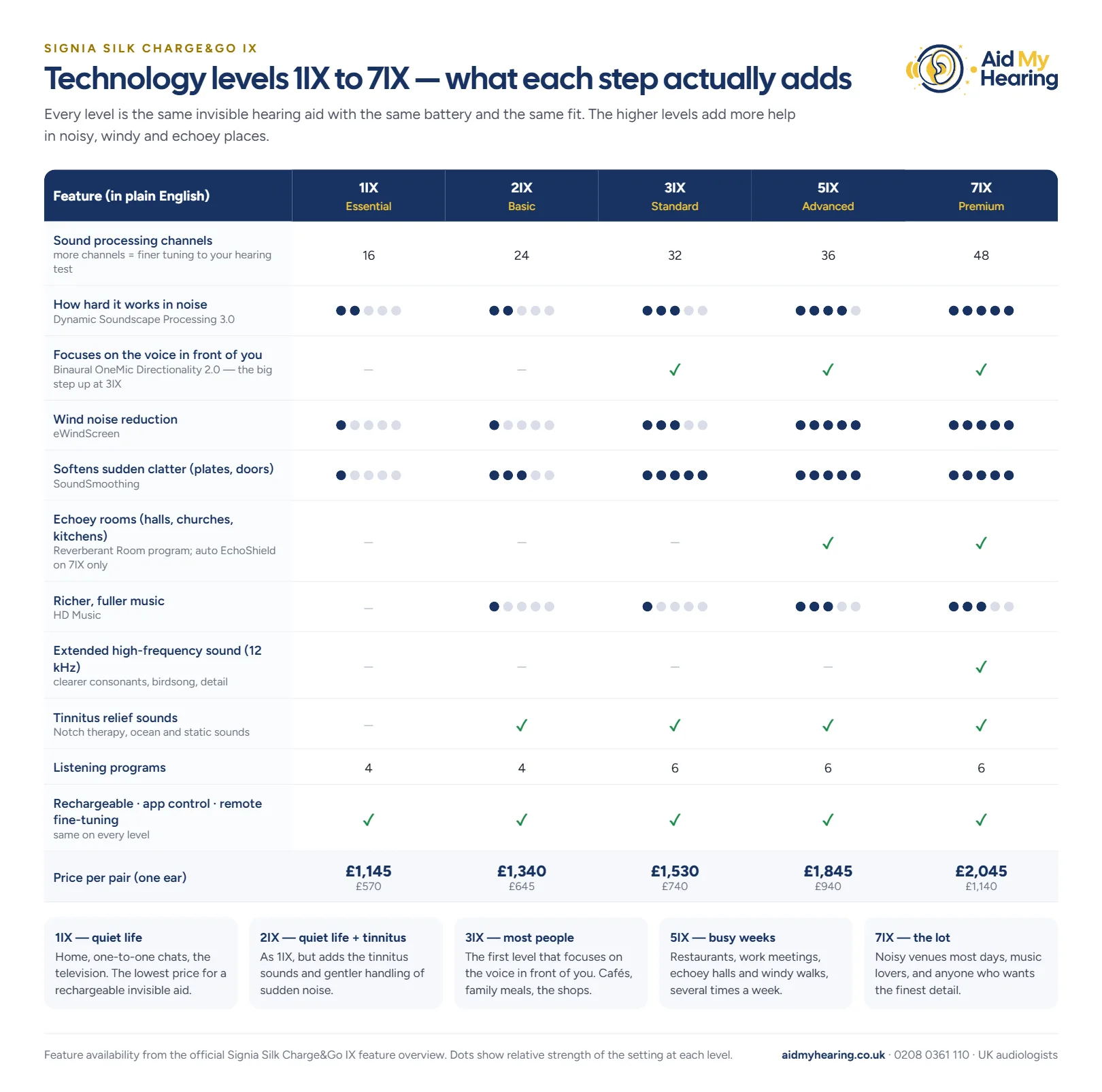
| 1IX | 2IX | 3IX | 5IX | 7IX | |
|---|---|---|---|---|---|
| Pair price | £1,145 | £1,345 | £1,540 | £1,845 | £2,045 |
| One ear | £645 | £745 | £840 | £945 | £1,100 |
| Sound channels | 16 | 24 | 32 | 36 | 48 |
| Focus on the voice in front (Binaural OneMic Directionality) | – | – | ✓ | ✓ | ✓ |
| Wind noise reduction (eWindScreen) | Basic | Basic | Medium | Full | Full |
| Sudden loud sounds softened (SoundSmoothing) | Basic | Medium | Full | Full | Full |
| Echoey rooms (Reverberant Room program) | – | – | – | ✓ | ✓ |
| Auto EchoShield | – | – | – | – | ✓ |
| Extended 12 kHz bandwidth | – | – | – | – | ✓ |
| HD Music | – | Basic | Basic | Full | Full |
| Tinnitus therapy sounds | – | ✓ | ✓ | ✓ | ✓ |
| Listening programs | 4 | 4 | 6 | 6 | 6 |
Silk Charge&Go IX. The Silk X follows the same pattern level for level (7X, 5X, 3X, 2X, 1X); directional focus starts at 3X.
Which level, honestly?
1IX or 1X — a quiet life: home, one-to-one conversation, the television. The most affordable way into an invisible aid, and a good first hearing aid for someone who mainly wants the family to stop repeating themselves.
2IX or 2X — as above, but you have tinnitus and want the relief sounds, or you are bothered by clattering plates and slamming doors.
3IX or 3X — the one most people should buy. The directional focus arrives here. Cafés, family meals, the shops, the school gate: this is the level that makes those easier rather than just louder.
5IX or 5X — restaurants, work meetings, church and village halls, windy dog walks, several times a week. The echo program and full-strength wind handling earn their keep here.
7IX or 7X — noisy places most days, music lovers, or anyone who simply wants the most natural, detailed sound Signia makes in this shape. The 7IX adds automatic echo control and the extended high-frequency range that brings back birdsong and consonants.
Not sure? Two minutes on the phone is usually enough for us to tell you. We will never talk you up a level you do not need — the 60-day trial means we would only be creating a return.
Call, or send us your hearing test and a few words about where you struggle. Our audiologist will reply the same working day with an honest recommendation — Silk IX or X, and which level — with no obligation to buy.
Signia Silk prices in the UK (September 2026)
Prices are for a pair unless stated, and include programming to your hearing test, the charger on rechargeable models, free UK delivery, free remote aftercare for as long as you own them, a 5-year warranty and our 60-day money-back trial. Single aids are available for people with hearing loss in one ear.

Why are these prices lower than you may have been quoted elsewhere? Because we are an online audiology practice: no high-street premises, no appointment overheads, and the same manufacturer’s devices. The saving is passed to you, and the clinical work — reading your audiogram, programming, fine-tuning — is done by a UK-registered audiologist rather than skipped. You can also spread the cost with Klarna at checkout.
Invisible (CIC) or behind the ear (RIC)? The honest trade-offs
If you are choosing between the Silk and a discreet behind-the-ear aid such as the Signia Pure Charge&Go IX, this is the comparison that matters. Neither is better; they suit different people.
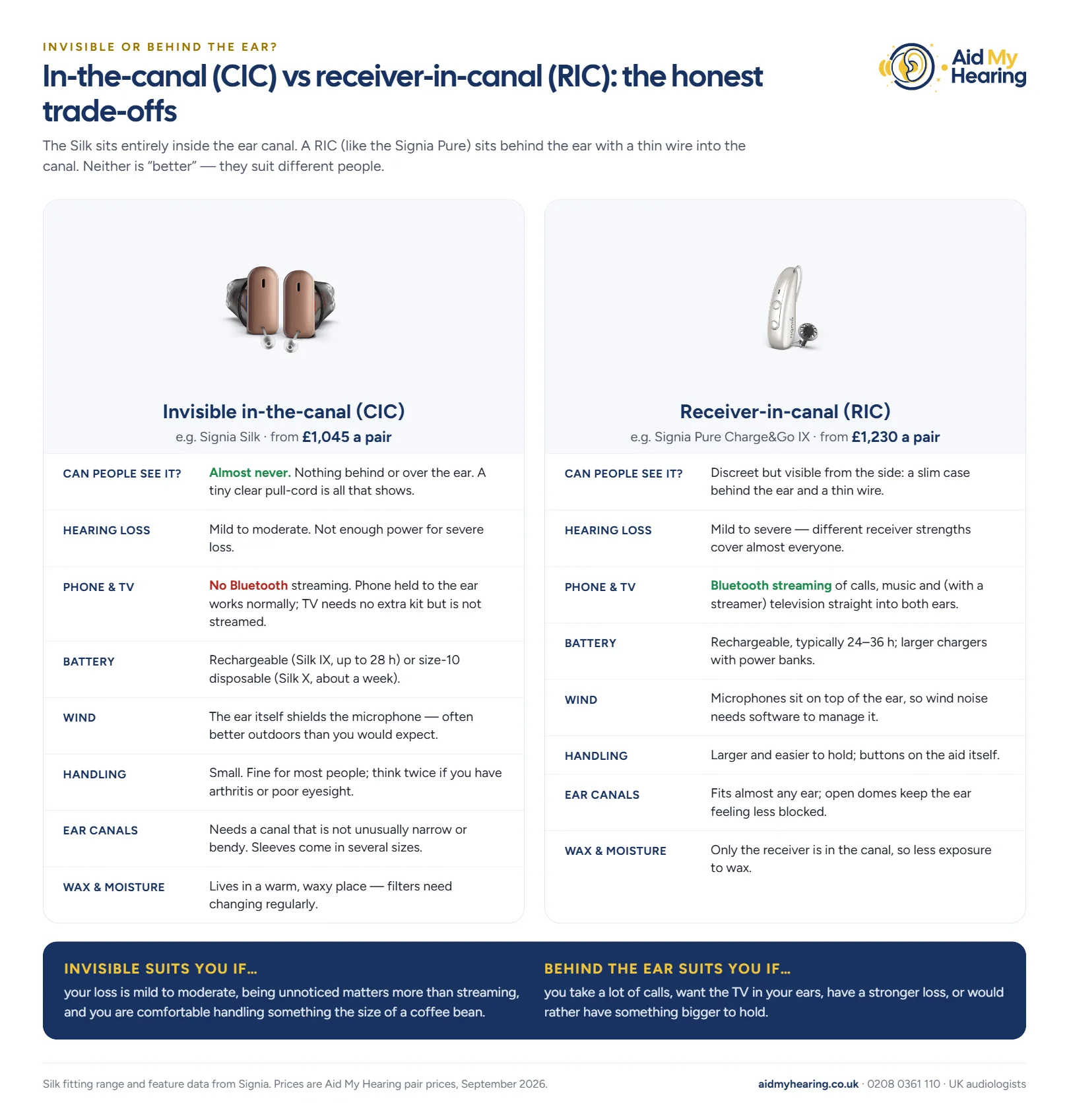
Two points people do not expect. First, the Silk is often better in wind than a behind-the-ear aid, because the ear itself shields the microphone. Second, a behind-the-ear aid with an open dome can feel less blocked than anything that fills the canal — if the feeling of your own voice booming worries you, mention it and we will choose the sleeve and settings to minimise it.
Living with the Silk: the details that matter day to day
Silk IX: lift them out of the case, they switch on. Silk X: they are simply on. A weekly battery change takes a minute.
Hold the body, guide the sleeve into the canal, a gentle push. Out again with the pull-cord. Most people are fluent within a week.
Volume and programs from the Signia App or the miniPocket keyring. No Bluetooth pairing to go wrong — the app talks to the aids with inaudible tones.
Hold the phone to your ear as normal. What you do not get is calls streamed into both ears — that needs a behind-the-ear aid.
Most people find they no longer need the volume up. For streaming straight into the ears, a RIC with a TV streamer is the answer.
Change the wax filter when sound goes dull (roughly monthly) and the sleeve every few months. We send a reminder and spares are inexpensive.

Battery life in real use. Signia rates the Silk IX at up to 28 hours, which in practice means a full day and evening with margin, and a couple of hours in the case at lunchtime if you are out very late. The charging case adds up to three further charges away from a socket, so a long weekend needs no plug at all.
Comfort. The IX has a soft, textured surface designed to sit gently against the canal, and the Click Sleeves come closed (more power, more sense of fullness) or open (more natural, for milder losses). Getting the sleeve right is most of the comfort battle, and it is a two-minute swap.
Hearing loss in one ear only. The Silk Charge&Go CROS sits invisibly in the ear that cannot be helped and sends what it hears to a Silk IX in the better ear, so you stop losing half the room. Call before ordering a CROS system so we can confirm it is the right approach.
“Cheap invisible hearing aids”: what to be careful of
It is one of the most-searched phrases in hearing care, and we understand why — the high-street price of a pair of premium hearing aids is a shock. But the very cheapest results online are usually not hearing aids at all. They are amplifiers, sold without a hearing test, that make everything louder — including the noise you were struggling to hear through — with no way to shape the sound to your loss.
The route that actually works for a limited budget is a genuine entry-level hearing aid from a major manufacturer, programmed to your audiogram, with someone to call when it does not sound right. That is what the Silk 1X at £1,050 a pair is: a real Signia hearing aid, invisible, fitted to you, with a 5-year warranty and 60 days to change your mind. If you are choosing between a cheap amplifier and nothing, please call us first — we will tell you honestly what your test suggests, whether or not you buy.
How buying a Silk from us works
Buying online does not mean buying blind. After you order, we send a five-minute questionnaire about where you struggle to hear, any previous hearing aids, tinnitus, and how you like sound to be. Your audiologist uses that and your hearing test to programme the aids before they leave us, so they arrive set up for you rather than on a factory setting. Wear them in real life, tell us what you notice, and we adjust them remotely — free, as often as you need, for as long as you own them. If they are not right within 60 days, send them back for a full refund. Read how our process works.
Our audiologist’s verdict
- Silk Charge&Go 3IX — £1,540 a pair
- First level with directional focus on speech
- Rechargeable, invisible, tinnitus sounds included
- Silk 1X — £1,050 a pair
- Genuine invisible Signia aid, programmed to you
- Weekly battery change; ideal for quiet lives
- Silk Charge&Go 7IX — £2,045 a pair
- Auto echo control, 12 kHz detail, full wind handling
- For noisy days, music and the finest sound

Signia Silk Charge&Go 3IX

Signia Silk 1X
Order the Silk IX or Silk X at any level, send us your hearing test, and it will be programmed to you before it ships. Sixty days to change your mind, five years of warranty, and an audiologist on the phone whenever you need one.
Frequently asked questions
At Aid My Hearing a pair of Signia Silk hearing aids costs from £1,050 (Silk 1X) to £2,045 (Silk Charge&Go 7IX), with single aids from £545. The rechargeable Silk Charge&Go IX range runs from £1,145 to £2,045 a pair. Every price includes programming to your hearing test by a UK audiologist, the charger on rechargeable models, free remote aftercare, a 5-year warranty and a 60-day money-back trial. High-street prices for the same devices are typically considerably higher because you are also paying for the premises and the appointments.
The Silk Charge&Go IX (2023) is rechargeable, with up to 28 hours from a charge and a pocket charging case that holds extra charges. The Silk X (2020) uses a size-10 disposable battery that lasts around 70 hours, so roughly a weekly change. The IX runs on Signia’s newer Integrated Xperience chip; the X runs on the previous Xperience chip. Both are the same invisible in-the-canal shape, both fit instantly with Click Sleeves, both are controlled with the Signia App, and neither streams Bluetooth audio. The Silk X is £90–£200 a pair cheaper, level for level.
For mild to moderate hearing loss, yes — a modern in-the-canal aid like the Silk uses the same sound processing as the behind-the-ear models from the same generation, and the ear itself gives the microphone natural protection from wind. What they give up is power (they are not suitable for severe loss), Bluetooth streaming, and a bit of ease of handling. If your loss is in the mild-to-moderate band and being unnoticed matters to you, they are a very good choice. If you need the television or phone calls streamed into your ears, a receiver-in-canal aid will make you happier.
No. Neither the Silk Charge&Go IX nor the Silk X streams phone calls, music or television by Bluetooth — there is not room inside an aid this small for the antenna and battery that streaming needs. You still control them from the Signia App on your phone (it talks to the aids with inaudible high-frequency tones) or with the miniPocket keyring remote, and the phone works normally held to your ear. If streaming matters to you, look at the Signia Pure Charge&Go IX, which is discreet behind the ear and streams everything.
The Silk Charge&Go IX is rechargeable: up to 28 hours from a full charge, around four hours to charge from empty, and a 30-minute top-up gives about six hours. It comes with a portable charging case that holds up to three extra charges, and the case itself can be charged wirelessly on a Qi pad. The older Silk X is not rechargeable; it takes a size-10 disposable battery that lasts around 70 hours.
For most people, the 3IX. It is the first level with Binaural OneMic Directionality, the feature that makes the two aids work together to focus on the voice in front of you — the single biggest step in the range. Choose the 5IX if noisy restaurants, meetings, echoey halls or windy walks are a several-times-a-week part of your life: it adds the Reverberant Room program, stronger wind and noise handling, and the fuller HD Music setting. If you are not sure, tell us how you spend your week and we will say honestly which one you need.
Generally not. The NHS provides very good hearing aids free of charge, but they are almost always behind-the-ear models chosen for reliability and cost. Invisible in-the-canal aids like the Silk are normally only available privately. Many of our customers keep their NHS aids as a spare and wear the Silk day to day.
Often, yes. The Silk fits with soft Click Sleeves in several sizes, so narrow canals can usually be fitted with a smaller sleeve, and a custom-made sleeve is available if the standard ones do not sit right. Very narrow or sharply bending canals are the exception; if a previous audiologist has told you your canals are unusual, mention it when you order and we will advise before anything ships.
Yes, on every level except the 1IX and 1X. Levels 2 to 7 include Signia’s tinnitus features: Notch Therapy, which is designed for a constant tone-type tinnitus, plus ocean-wave and soft static sounds you can switch on from the app when you need them. Simply hearing the world properly again also takes the edge off tinnitus for many people, because the brain has less silence to fill.
“Cheap” online usually means one of two things: an unregulated amplifier that is not a hearing aid at all, or a genuine hearing aid sold without any programming or aftercare. The first makes everything louder, including the noise you are trying to hear through. The second arrives on a factory setting and often ends up in a drawer. The affordable route that works is a genuine entry-level aid, programmed to your hearing test and supported afterwards — which is exactly what the Silk 1X at £1,050 a pair is.
Related reading
- Signia Silk Charge&Go IX review — our audiologist’s in-depth review of the rechargeable Silk
- Best hearing aids of 2026 (UK) — our picks by situation, including best invisible
- Signia Pure Charge&Go IX levels explained — the behind-the-ear alternative
- How buying from us works — test, questionnaire, programme, deliver, adjust



Contact Aid My Hearing
If you have any questions, need advice, or would like more information about our hearing services, please complete the contact form and a member of the Aid My Hearing team will get back to you as soon as possible.
Prefer to speak to us directly? Call 0208 0361 110 or email info@aidmyhearing.co.uk
